




A cashmere or fine-knit sweater can tighten from heat and agitation, lengthen when its wet weight is unsupported, and pill wherever soft fibers rub. Before trying a remedy, read the whole label, examine the knit in neutral light and decide whether its present condition is strong enough for home handling.
Read the change before trying to correct it
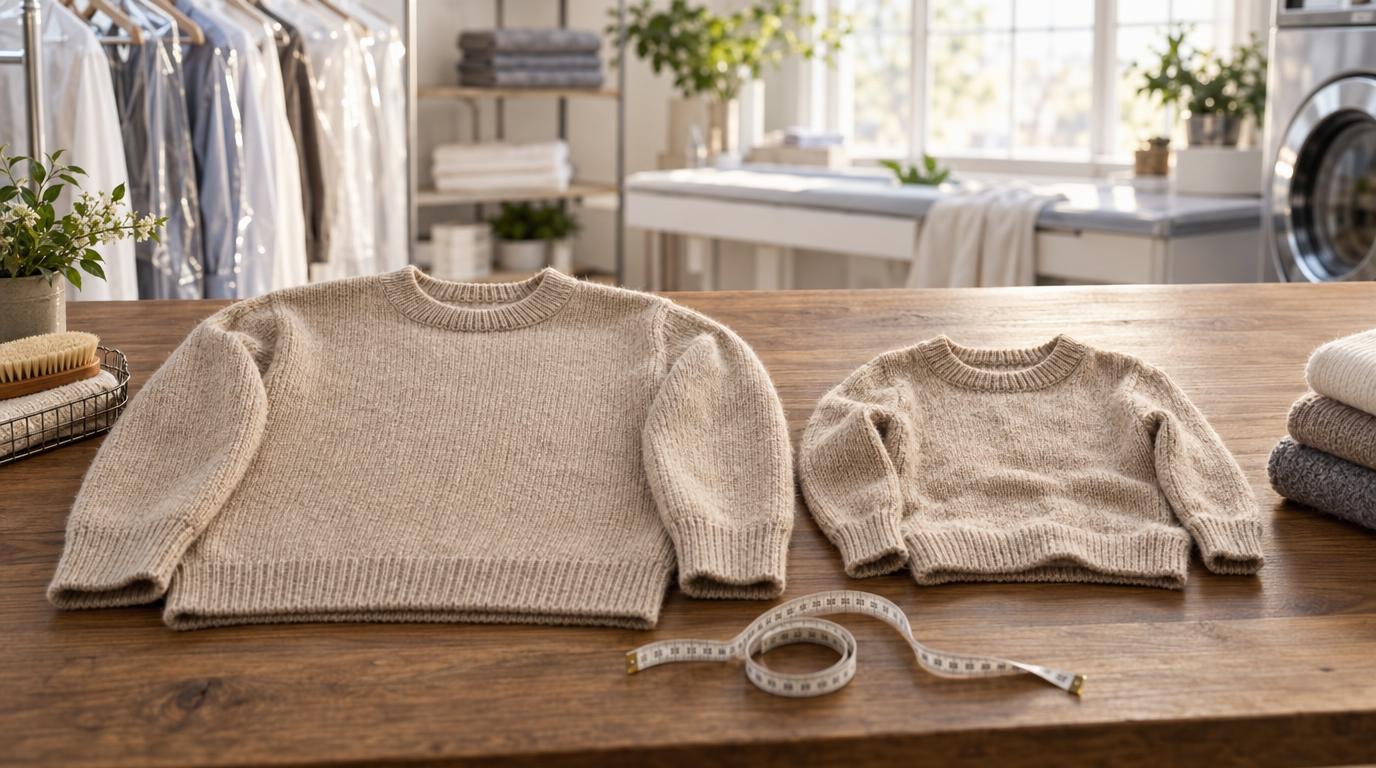
Shrinkage, stretching and pilling are not three names for the same problem. A tightened sweater may have relaxed loops that changed dimension, or it may have felted so the fibers have locked into a denser surface. A stretched shoulder may come from hanging, while a long hem may reflect the pull of water during drying. Pills are loose surface fibers tangled by repeated contact.
Begin with the sweater resting on a clean white sheet. Compare both sleeves, the side seams, neckline and ribbed edges without pulling. Then look across the surface rather than straight down. Shine, flattened nap, thin areas, broken yarn and small holes change what can safely be attempted. An older or hand-finished piece may also have weak seams that are not obvious while it is folded.
La Crescenta Cleaner is on Foothill Blvd in the Crescenta Valley, where a special knit can be examined before more moisture, friction or heat is introduced.
When the knit feels dense, the color has moved or a weak area appears, pause home treatment and Call.
Let the complete garment label set the boundary
The fiber-content label tells you what the yarn contains, but the care label tells you a supported regular-care method for the assembled sweater. Federal Trade Commission guidance requires that instruction to account for the whole product, including non-detachable trim, closures, decoration and lining. That distinction matters when a cashmere body has leather tabs, covered buttons, embroidery or an adhesive-backed detail.
Dryclean Only warns that washing may harm the piece. A Hand Wash instruction is permission only for the water temperature, handling, detergent and drying steps stated or implied by the complete label. If the wording has faded, a symbol is unclear or a replacement trim behaves differently from the body, do not fill the gap with a general rule for cashmere.
Choose care by construction as well as fiber
| Fine-knit type | Label-safe starting point | Reason to request an assessment |
|---|---|---|
| Plain cashmere jersey | Use the exact label. Support the piece fully, avoid rubbing and reshape only while the permitted method leaves it damp. | Dense felting, dye movement, an old stain or a missing instruction. |
| Merino or fine wool | Keep the wash and drying method inside the label boundary; dry flat when directed. | Distorted ribbing, pulled seams, insect evidence or a roughened face. |
| Mohair angora or alpaca | Minimize handling and preserve the raised surface. Do not brush simply because the fiber looks fluffy. | Matted nap, shedding, open construction, trim or shape loss. |
| Cashmere blend | Read the listed percentages and the complete care instruction; the softest fiber does not decide alone. | Different fibers or panels react unevenly, or the piece contains stretch yarn. |
| Beaded embroidered or heirloom knit | Keep the piece flat and protect loose work while inspecting it. | Weak yarn, unstable color, ageing thread, covered fasteners or previous repairs. |
Two sweaters with the same fiber percentage may still require different care because yarn twist, knit density, dye, finish and decoration change the risk. The table is a starting point for reading the piece, not a substitute for its instruction.
Control water movement and drying without forcing the knit
If hand washing is permitted, prepare a clean basin and complete the process without leaving the wet sweater unsupported. Move the garment gently through the water rather than rubbing one area. Lift it as a supported bundle, press water into a clean towel and transfer it to a flat drying surface. Do not twist the body, hang it from the neckline or use high heat to hurry the result.
A dryer should not be used to make an enlarged sweater smaller. Even when a label permits tumble drying, its allowed temperature and cycle still matter. Unplanned heat and tumbling can tighten one panel, roughen a raised surface or make ribbing react differently from the body. Woolmark advises flat drying for wool unless the individual label allows another method.
- Photograph the sweater flat before cleaning so the original proportions and asymmetry are recorded.
- Read the fiber percentages, care method, drying direction and every warning before choosing equipment.
- Test no home remedy on a stained, fragile, highly decorated or dry-clean-only piece.
- During permitted washing, support the full wet weight and avoid concentrated rubbing at cuffs and underarms.
- Return the damp sweater only toward its natural outline, then let it dry undisturbed on a breathable surface.
Treat pilling as a surface condition with limits
Pills form where fibers rub against the body, another garment, a bag strap or furniture. Their presence does not prove that a sweater was washed incorrectly. Before removing them, clean the garment by its approved method and spread it on a stable surface. Lift only loose balls with a fine sweater comb or guarded fabric shaver, using light passes in one direction.
Stop if the tool catches a loop, exposes a thin patch or changes the nap. A fuzzy halo can be part of the intended finish on mohair or brushed cashmere, so aggressive shaving may remove sound fiber rather than damage. A run, hole or weak seam belongs in a repair conversation before further grooming.
Store a fine knit without adding new distortion
Allow the sweater to become completely dry and cool before storage. Fold it with the shoulders aligned and avoid a hard crease through beads, embroidery or fragile yarn. Acid-free tissue may soften a fold when the material and condition make that appropriate. Keep heavy objects off the pile and leave enough room that a raised surface is not compressed.
Clean storage matters because body oil and small food marks can darken over time and attract insects. If webbing, grains, shed fiber or holes appear, separate the affected piece and inspect nearby animal-fiber garments. Cleaning can address soil on the garment, but it does not rebuild missing yarn or correct the storage area by itself.
Questions we are asked most
Can cashmere be unshrunk?
A washable cashmere knit that has relaxed slightly may respond to label-safe dampening, careful blocking and flat drying. A dense felted surface is different because the fibers have interlocked. Repeated soaking, conditioner mixtures or hard pulling can weaken the garment without restoring its former dimensions. Ask for an assessment if texture and size changed together.
Should every cashmere sweater be dry cleaned?
No. Some cashmere garments carry a safe hand-wash method, while a Dryclean Only instruction warns against washing. Follow the exact label attached to that sweater. The stain, dye, trim, knit structure and present condition may still make professional evaluation prudent even when the fiber itself is washable.
Can I remove pills from an heirloom knit?
Only after checking that the yarn and surface are stable. Work flat, use the least aggressive tool and keep away from handwork, seams and thin zones. If a pill is connected to a long fiber, do not pull it. Snip nothing near an uncertain loop, and stop when grooming changes the surrounding texture.
To discuss a fine-knit sweater, call (818) 475-7575 or book a consultation. Bring the care label and any detachable trim with the garment.